TUNLNET
A NEW ERA IN TUNNEL DETECTION
TunlNet is a passive underground monitoring system engineered to detect covert tunneling operations before they become security threats. Unlike legacy systems that rely on active scanning or labor-intensive inspections, TunlNet uses a breakthrough sensing modality to deliver continuous, adaptive, and low-maintenance detection - even in environments where traditional technologies fail.
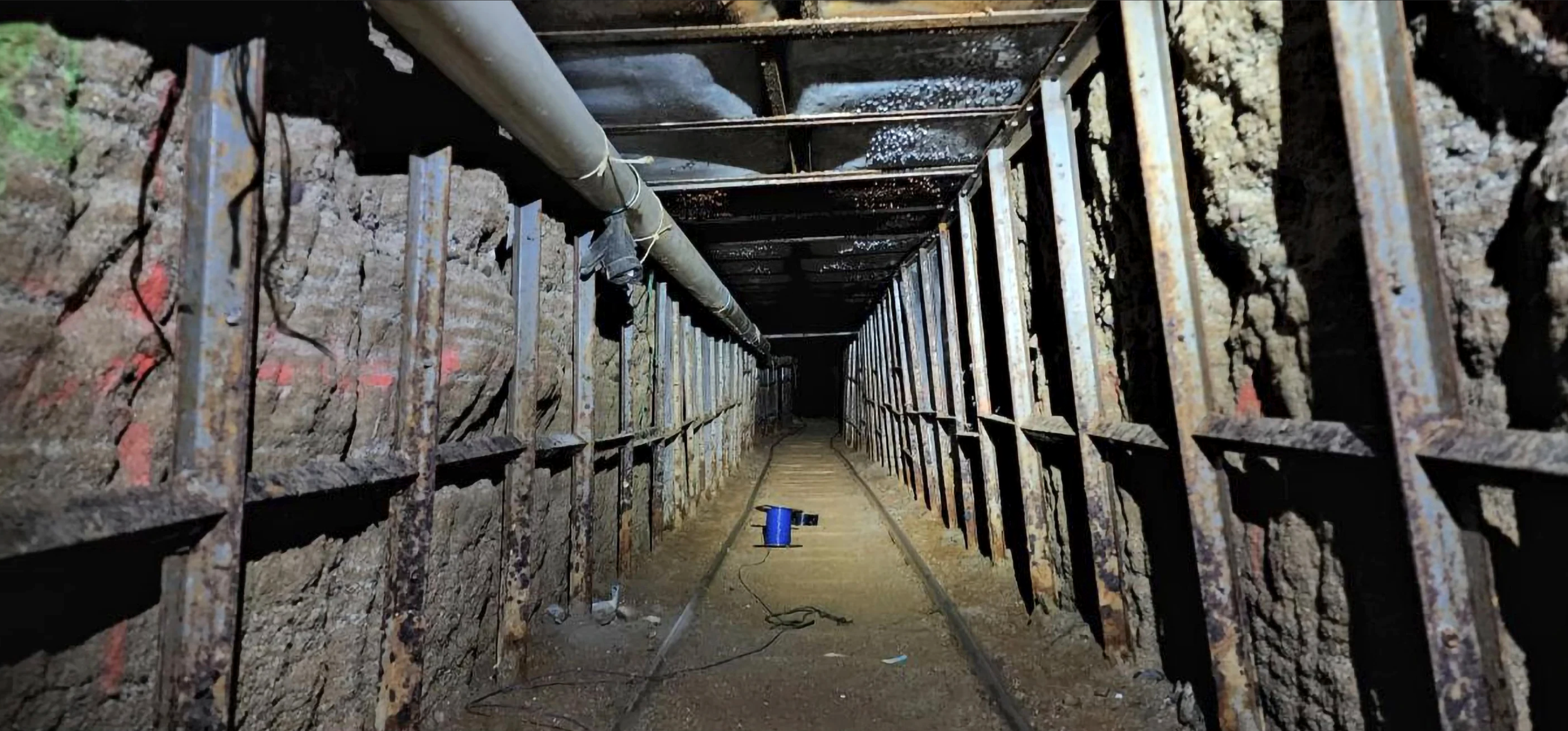
US Customs & Border Protection / AP
TunlNet
allows you to:
Detect underground tunnels
Determine tunnel length and depth
Monitor for new or expanded tunneling
Receive alerts when tunnels are detected
Scale across large geographic areas
ideal for:
Border security
Prison perimeter defense
Critical infrastructure protection
Private estates & industrial facilities
Conflict zones or high-risk geographies
TunlNet integrates easily with other surveillance systems or can operate as a standalone early-warning layer.
why tunlnet is better
Most tunnel detection systems rely on a narrow set of tools - seismic, radar, acoustic, or electromagnetic sensors - that work only in ideal conditions. But in the real world:
Deep tunnels evade detection by surface-based geophysical methods.
Highly conductive or clay-rich soils disrupt electromagnetic and radar sensing.
Ambient noise from highways, airports, and industrial areas masks tunnel signals.
Most tunnels are discovered by accident or human tip-offs - not by technology.
tunlnet solves the problem differently.
Self-adapts to any geology
Reliable in clay, sand, rock, and mixed substrates.
immune to surface noise
Works near airports, highways, and other electromagentic sources without interference.
stronger on deep tunnels
Outperforms traditional systems below 40 meters.
passive and continuous
No active emissions, no manual scanning, no blind spots, and no off days.
inexpensive and scalable
Simple to install and operate - no special training or high energy input required.
How TunlNet works
it detects tunnels by listening to how natural air pressure moves through the ground.
Atmospheric pressure from weather is always changing. In normal soil, the ground slows down how those pressure changes move underground. But when a tunnel is nearby, it disrupts that flow.
TunlNet™ uses simple underground sensors to measure these changes. When a tunnel is created or expanded, the way pressure moves through the soil shifts. Our system detects that shift.
Because TunlNet™ uses natural signals, it does not need radar, sonar, or other active scanning tools. It quietly monitors the area at all times, even in loud or complex environments, and alerts you when it sees signs of tunnel activity.
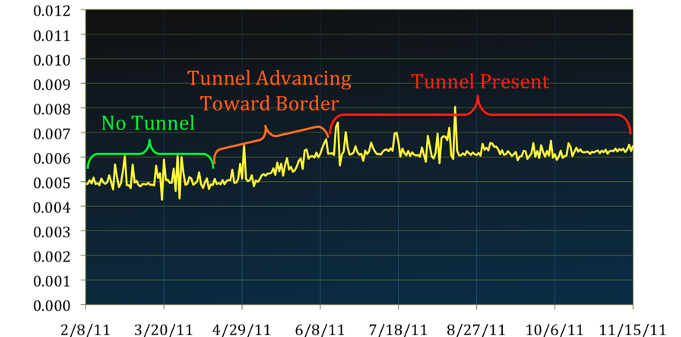
Tunnel signature as seen by TunlNet based on a simulation using data from Otay Mesa.
TunlNet uses a proprietary sensing modality not employed by other systems, enabling detection under the most challenging conditions.